Participation & Engagement
For us, the Child’s Voice is more than just speaking and means:
Considering me and my views and rights
at all levels of decision making,
in all encounters, in everyday spaces
‘Everywhere I Am’.
Children and Young People from Cornwall and The Isles of Scilly asked us to develop a unifying motto for use across OSCP about our shared commitment and approach towards involving them in service design and delivery.
We developed this pledge based on what they said…
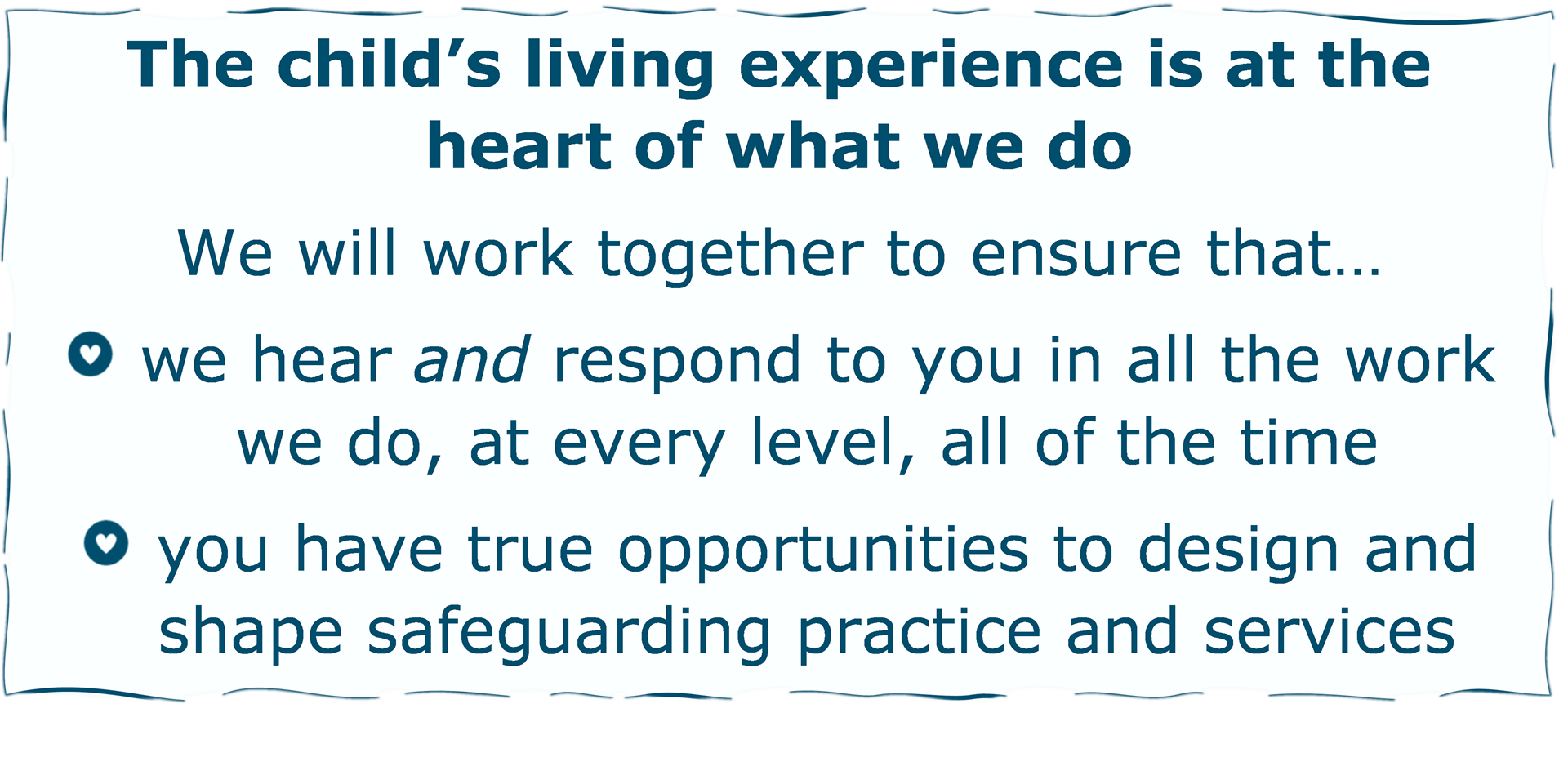
This means we will provide every day inclusive engagement opportunities for all.
To help us do this we have developed an Participation & Engagement Framework for all agencies and practitioners across OSCP who have signed up to the pledge.
It is based on what children have told us and asked for so far.
You can view the Framework here.
Other Resources
Effective participation can support children to understand their identity, make sense of the past and build lasting relationships.
For children who have experienced disruption, harm, danger or trauma, being seen and heard is crucial.
It is the job of child and family professionals to ensure this happens
Not Just Verbal – Communication with ALL C&YP
The voice of the child is more than just speaking. We know that the term ‘voice’ is often used as a shorthand for very complex communication and processes of interpretation.
Have a look at this page Not Just Verbal for more tips about communication with ALL children and young people.
The Child’s Voice & Domestic Abuse
We have developed a toolkit to equip practitioners with the skills, knowledge and confidence to hear and respond to the voice of the child in situations of domestic abuse.
The toolkit contains quotes from children throughout & case studies co-written with young parents. Groups of young people reviewed & approved the final draft.
Cultural Capability Practice Guidance
Intersectionality, or how a child’s social identities such as race, sex, gender, sexual orientation and other characteristics interconnect, is important for us to consider in terms of how it may impact the daily life experiences of the child as well as influence the decision-making of practitioners.
We have published some Cultural Capability Practice Guidance to help us to achieve this.
Ongoing participation work across OSCP focussed on safety and identity has provided input from a diverse range of children and young people who have multiple perspectives in terms of age, gender and abilities including neurodiversity, sexuality and life experiences. Their feedback is woven through this document as quotes.
Babies Voice Resources
Coming soon - Babies Voice Resources will be available here.
It can be hard to keep the ‘voice of the child’ in focus as babies cannot verbally communicate. This exacerbates their inherent vulnerability and makes it more challenging to assess indicators of their wellbeing. It is our job to create ways in which the voices of babies and very young children can be heard.
These resources have been developed by a multi-disciplinary and multi-agency working group to provide guidance on how to hear and respond to the voice of babies and very young children in all settings.
Learning from Serious Safeguarding Cases
We have published several briefings in response to serious child safeguarding cases to ensure that the learning is appropriately shared across Cornwall and The Isles of Scilly.
You can read more about the processes here
and this Learning from Experience briefing is particularly relevant to hearing and responding to the voice of the child.
- There is information for children available here about how to get involved with our work
- And more about children's rights here